
ACFT Events In Order (AFT Updated) 2026

In July 2025, the Army Combat Fitness Test (ACFT) was upgraded to the Army Fitness Test AFT). The Army Fitness Test (AFT) consists of five events, excluding standing power throw. The AFT events include 3-Repetition Maximum Deadlift, Hand-Release Push-Up, Sprint-Drag-Carry, Plank, and Two-Mile Run. These events test various abilities of soldiers, including strength, running, endurance, and aerobic power. Failing an events means that the soldier is failed the ACFT. Below is the detailed breakdown of ACFT events.
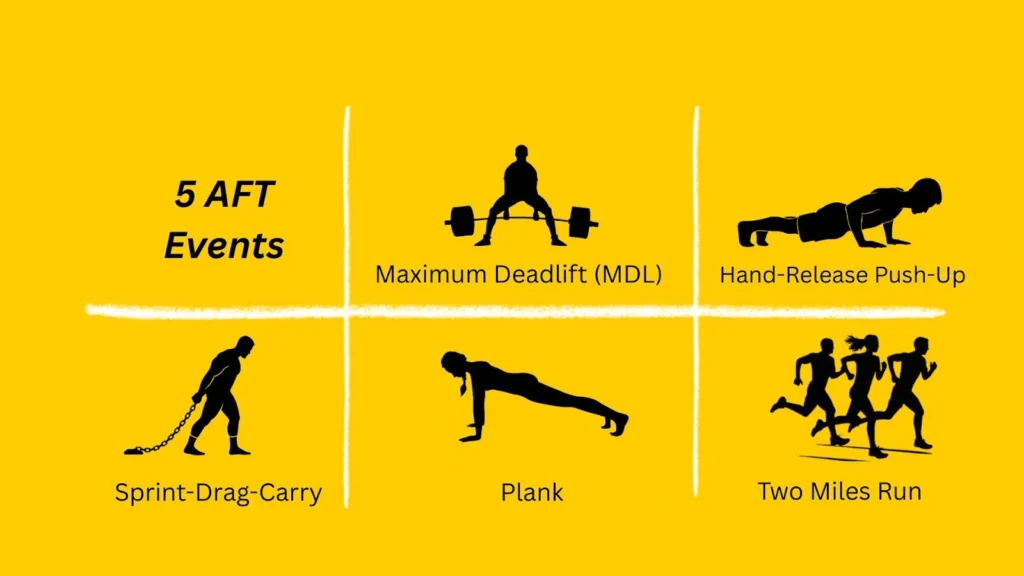
Army Fitness Test Events In Order
The Army Combat Events is a combination of five different tests. These events test the various physical abilities a soldier must possess to perform effectively on the battlefield. Each soldier is given with the ACFT score chart for the calculation of events score.
Here is the detailed breakdown of each ACFT event in order:
Tip: Use the ACFT score calculator to calculate your scores.
Three-Repetition Maximum Deadlift (MDL)
The Three-Repetition Maximum Deadlift (MDL) is an AFT event to test the muscular strength of soldiers. The main purpose of this event is to test a Soldier’s maximum lower body strength, including the muscles of the hips, legs, core, and grip. It polishes the ability to safely and effectively lift heavy loads from the ground.
Process
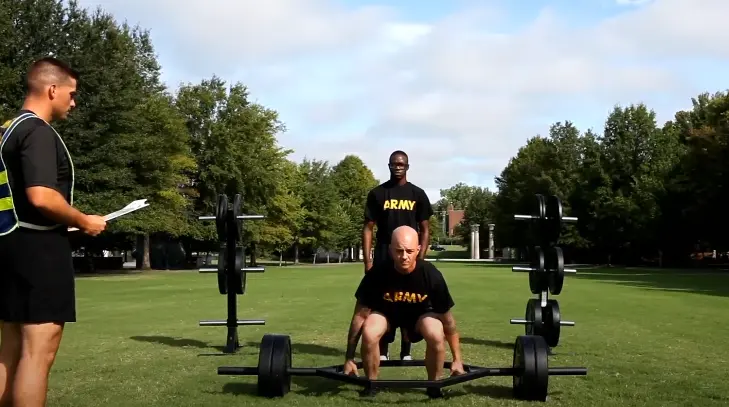
On the command “Get set,” the Soldier steps into the bar and assumes the straddle stance with ankles centered inside the hex bar and aligned with the midpoint of the hex bar handles. The Soldier bends at the knees and hips, reaching down to grasp the center of the handles, with arms straight back, flat head in line with the spine, or neck slightly extended, and feet flat on the floor.
The Soldier then straightens the knees, hips, and trunk, lifting the weight until reaching an upright stance. After a short pause in the upright position, the Soldier lowers the weight under control until it rests on the ground. This movement is repeated two more times to complete the event.
Equipment Details
Equipment | Description |
Hex Bar | 60-pound hexagonal bar used for lifting |
ACFT max deadlift weight | Plates added to the hexa bar, weight range from 120 to 340 pounds |
Platform | Solid surface to place the hex bar for lifting |
Hand-Release Push-Up (HRPU)
The Hand-Release Push-Up (HRPU) is the second event of AFT. The soldiers are passed through this event to test their upper-body muscular endurance and flexibility. This event helps the soldier to boost their skills, like pushing and controlling their body weight during battle.
Process
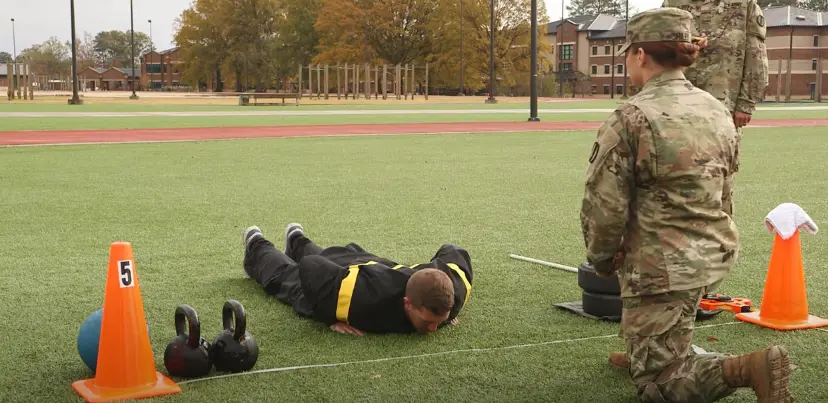
On the command “Go,” the first movement is the push-up from the ground into the front-leaning rest. This movement ends when both elbows are fully extended. The hips and trunk must leave the ground at the same time and move as a unit. The legs, hips, trunk, and head must remain in a straight line throughout the exercise.
The second movement is to flex the elbows and return to the starting position. The third movement is the hand release: without moving the head, body, or legs, the Soldier will fully extend their arms to the side. Hands may be on or off the ground.
The fourth movement is a return to the starting position with hands under the shoulders. This completes one repetition of the hand-release push-up. Here’s the exercise in real time.
AFCT Pushup Equipment
No equipment is required for this event. It is performed on a flat surface where solisers use their own body weight as resistance.
Sprint-Drag-Carry (SDC)
The Sprint-Drag-Carry (SDC) is designed to measure a Soldier’s total body strength, endurance, agility, and anaerobic capacity. It polishes the soldier’s combat abilities, such as sprinting, dragging a casualty, lateral movement, and carrying heavy equipment.
Process
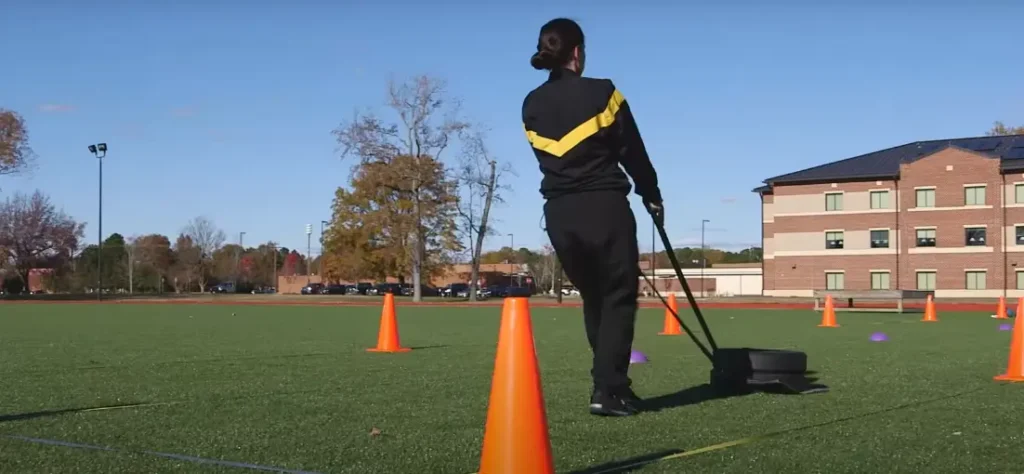
On the command “Go,” the Soldier stands and sprints 25 meters, touching the 25-meter line with both hand and foot. The Soldier then turns and sprints back to the start line. Next, the Soldier grasps each strap handle, which rests on the sled behind the start line, and drags the sled backward until the entire sled crosses the 25-meter line. After turning the sled around, the Soldier drags it back until the entire sled crosses the start line.
When the sled crosses the start line, the Soldier drops the straps and begins the lateral shuffle portion, performing a lateral shuffle for 25 meters. The Soldier touches the 25-meter line with hand and foot, then shuffles back to the start line. The Soldier faces the same direction moving to and from the line, leading first with one foot and then the other, shuffling without crossing feet.
For the carry portion, the Soldier grasps the handles of two 40-pound kettlebells with a closed grip and runs 25 meters to the line, carrying the kettlebells at their sides. Upon stepping on or over the 25-meter line with one foot, the Soldier turns and runs back to the start line. After stepping on or over the start line, the Soldier carefully places—but does not drop—the kettlebells on the ground beyond the line.
The Soldier then turns and sprints back to the 25-meter line, touching it with hand and foot, before sprinting back to the start line. The time is stopped when the Soldier crosses the finish line after this final sprint. This sequence emphasizes explosive power, endurance, and coordination critical for combat readiness.
Equipment Details
Here are the equipment details for the ACFT Sprint Drag Carry (SDC):
Equipment | Description |
Weighted | 90-pound sled |
Strap Handles | Attached to the sled for gripping and dragging |
Two 40-pound Kettlebells | Carried during the carry portion of the event |
Marked Course | 25-meter marked line for sprint, drag, lateral, carry, and sprint segments |
Flat, safe surface | Suitable for sprinting and lateral movements |
AFT Plank
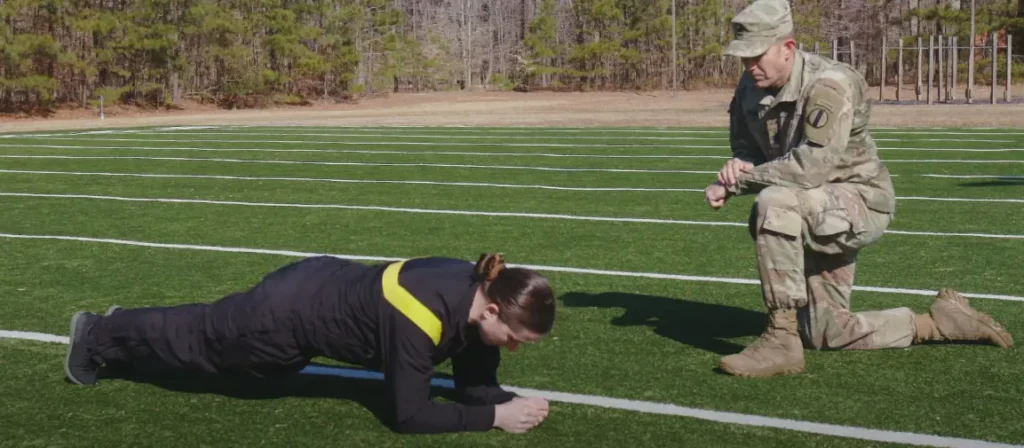
Soldiers are passed through the Plank test to check their core strength, muscular endurance, and balance. The main purpose of this event is to train the soldiers to maintain the strength and stable core for a long period of time. This test helps the soldiers to develop overall physical readiness and injury prevention skills in combat situations.
Process
On the command “Get ready,” the Soldier will place his or her hands on the ground either in fists with the pinky side of the hand touching the ground or lying flat with palms facing down, no more than the grader’s fist width apart. The hips should be bent with one or both legs resting on the ground. Once all Soldiers are in the ready position, the grader will issue the command “Grader’s ready.”
On the command “Get set,” the Soldier lifts both knees off the ground and moves the hips into a straight line with the legs, shoulders, head, and eyes focused on the ground, similar to the front-leaning rest. The Soldier’s feet may be up to the grader’s boot width apart. Elbows are aligned with the shoulders, together with the forearms forming a triangle. Ankles are flexed with the bottom of the toes on the ground. The Soldier maintains the body in straight alignment from the head to the ankles. The fingers on the left hand may not be interlocked or interlaced with the fingers on the right hand.
On the command “Go,” the OIC, NCOIC, or grader starts the clock, and the event begins. The OIC, NCOIC, or grader will call out the time in 15-second intervals until completion of the event. To attain proper plank position, the head, shoulders, back, hips, and legs must remain in a straight line from head to heels throughout the event. Feet, forearms, and fists or palms must remain in contact with the floor throughout the event.
Equipment Requirements
No special equipment is required for this event. The soldier has to maintain a particular position on a flat surface as much as possible.
Two Mile Run
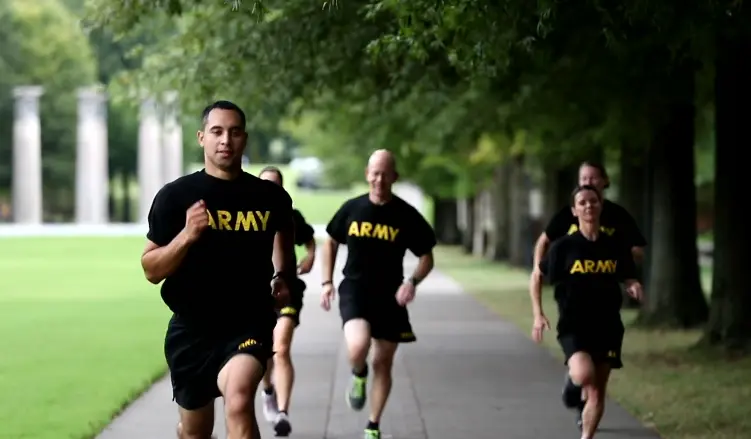
The Two Mile run is the final ACFT event that tests the aerobic endurance of the soldiers. In this test, Soldiers must complete the two-mile run as soon as possible. The event time is based on age, gender, and Military Occupational Specialty (MOS).
Process
On the command “Go,” the clock starts, and Soldiers begin running at their own pace. The soldiers have to complete the two-mile distance without being pushed, pulled, or physically held in any way.
Equipment Requirements
There is no such equipment required in the two-mile run event. In this test, soldiers have to complete the two-mile track in the minimum possible time.
ACFT Alternate Events
The ACFT alternate events are the aerobic power tests. These options are available to Soldiers who have permanent medical profiles that prevent them soldier from completing the standard 2-mile run. Here is the list of recognized alternative aerobic events:
- 2.5-Mile Walk
- 1,000-Meter Swim
- 15,000-Meter Stationary Bike
- 5,000-Meter Row
Soldiers must complete one of the following events within a specific time period to fulfill the AFT alternate events standards.
Time Between AFT Events
In the US Army Combat Fitness Test, there is no necessary rest time between each event. The rest time between each event is determined by the test administrator. However, a good rest time is given between each event of AFT before moving to the next event.
Example :
Once a soldier completes the Hand-Release Push-Up event, Soldiers might get a few minutes to recover before starting the Sprint-Drag-Carry. However, there is no fixed rest time between the events.
FAQs
Conclusion
The Army Fitness Test (AFT) was updated in 2026. It is replaced by the ACFT with five core events: 3-Repetition Maximum Deadlift, Hand-Release Push-Up, Sprint-Drag-Carry, Plank, and Two-Mile Run. The ACFT events are designed to test the strength, endurance, agility, and aerobic power of soldiers.
Soldiers must score a minimum in each event to pass, with alternate aerobic options available for those with medical profiles. This test promotes overall fitness, mental toughness, and battlefield performance.
